Friday, July 17, 2015

July Blues

Well after a long extended period of wetness, now the heat and humidity of normal July are about to return.  We are battling a few issues, mostly related to the elements.  One I've mentioned before is disease  in the rough (every where actually).  Due to the mixed bag of grasses in the rough, at any time multiple diseases are attacking multiple grasses.  I mention this as the picture below shows the difference between a pure stand of tall fescue and the heinz 57 we have.


Above on the left is pure tall fescue, no disease;  same as below left which is new tall fescue sod around the fairway on 15


Whenever I talk about summer and poa annua it always comes down to roots.  High temperatures and saturated conditions mean this shallow rooted plant struggles to compete.  The wet conditions created a situation where the plant had no reason to drive roots deep, so they are even shallower than normal.  The exception seen below is where we have an aeration hole and sand.  That drier condition allowed the plant to put down a few more roots.  It can even be seen that they are very white and healthy.


 This past year we purchased a deep tine aerator that we use in the fairways.  This great picture of some fairway turf shows the effect of an aeration hole and rooting.  Although we have only been able to perform minimal aeration, the results are amazing when air can get into the ground.


Sunday, July 12, 2015

Uuuuugh.

Well since my last post there has been another 2+ inches of rain, every day of July so far.  This will not be another pity us blog, but I do want to point out a few things that concern us, but also alert members to some issues that we have no control over.

First, the many issues of being too wet I mentioned in the past post, but here is an example of uncontrollable disease.  The picture below show how affected the rough is to this type of weather.  We do very limited spraying of the rough, but because of our heinz 57 mix, almost any grass can be attacked by any disease in this type of weather pattern.

We would have to spray on a 5-7 day schedule to stop this


 This large limb shown below is from the large Oak at the 7th tee.  This was not storm related, it just dropped one day.  I point this out to be careful when your out there.  The tree and the limb seemed healthy with no obvious signs of distress.  Many of our trees are aging and most were planted at the same time, so as we see some decline around the course, we anticipate others will follow.  Especially trees that see this much traffic around them are more susceptible.  Again this is just to warn you to where you park, or stand.


I mentioned in the last post about the puffy tees.  We performed a heavy verticutt last week to remove excess thatch and apply a sand topdressing.  You can see from this picture how much material we pulled out of the tees.  Again this is not a great time to do this, but the scallping was becoming an issue.  We hope to see these heal in the next few weeks.


Lastly a little information about our lower area below the range parking lot.  It has been mentioned several times that we should reduce the size of the lower area to make the spot more attractive when leaving the 4th tee.  This is a picture of the trucks that deliver sand and compost.  They not only need space to access the area, but also turn around and leave.  A real challenge given our small entrance and tight quarters.  I struggle to find another location that is accessible for these size trucks, which has become the standard for the companies suppling our materials.  We will continue to look for solutions, but you can see we need to plan for these essential supplies.


Thursday, July 2, 2015

Rain Rain Go Away...

I remember this little rhyme from grade school and it has never been more appropriate than now.   This is a year of guessing what month are we in now.  April was one of the coldest on record, May the hottest and driest ever ( that 158 years of record keeping) and now June goes down as the wettest ever.   We are switching gears every day on what to do, where to mow and how not to damage what we have.

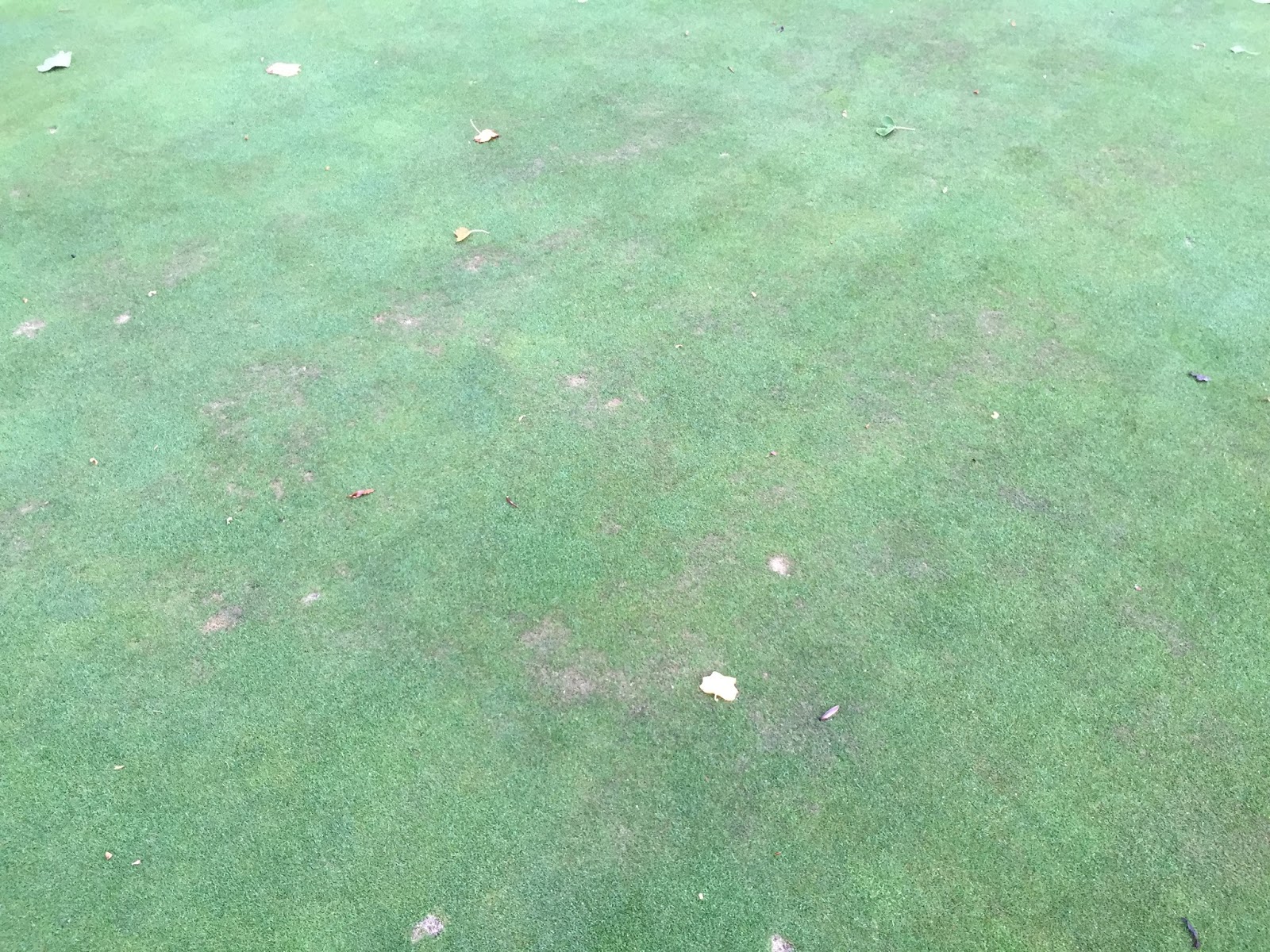
Just this past 10 days we have witnessed 6 inches of rain at our course.  With old soil greens that do not drain that means dealing with the issue of mowing.  Seems simple, but the weight of the mowers pushes into the turf and causes the mower to scalp the grass, resulting in critical damage to the plant.   Again it does not take much to hurt a tender grass grown at 0.115" tall, in a hot and now very humid environment.  So please be patient while we raise cutting heights, maybe roll some days instead of mow, all in the attempt to reduce damage so when the pattern changes we can return to normal conditions.

As many heard me at the town hall, the 4th green has already started it's slow decline that we witness yearly.  All the rain water from the surrounding homes, draining onto a flat, slow draining green built in a low area surrounded by trees and tall houses is a recipe for problems.


What happens first are the roots start to die back from excessive wet soil, then the water heats up during the day and slowly cooks the roots.  Soil temperatures last week reached over 95 degrees in the soil..  roots stop functioning at 80 degrees, so not hard to guess what happens at 95.


Next algae starts to fill in and suffocates the pore space, leading to the thinning of the grass.


The above is a shot of the roots as seen through our microscopes.  We look at the root hairs to see if there are any other issues, such as disease or nematodes that may be affecting the plant as well.  To give you perspective, the white round things are individual grains of topdressing sand.

We will begin a series of treatments to improve the health of the grass if the weather cooperates.  Then begin an over-seeding program of new bent grass varieties to see if we can get some growth back.  All of this is made more difficult during the hottest and most stressful part of the year, but doing nothing will only lead to more dieback and I hate waiting; doing nothing.  


In addition to the greens we also see this excessive heat and humidity leading to other issues.  You will notice some tees with a scalped look along the edges.  The first, fifth and 13th tee all exhibit the look you see below as well as a few others.   When the humidity raises to high levels, the bent grass becomes puffy causing the mowers to sink into the top and scalp the grass.  There are a multitude of reasons but all of them are related to the humidities effect on the turf.  We can attack this problem better in the fall, but will try a few ideas at some selected spots in the meantime.


The most disappointing effect of all this excess water is the damage to the 15th fairway.  Over the winter we hoped to improve the end of the landing area.  We widened the area, planted bent grass and had hoped to install new drainage.  Unfortunately the winter froze us out of completing this part of the work.  As you can see all the water sits in the new widened fairway area, which has drowned most of the bent grass.  Persistent shade, excessive water and damage from carts and mowers has rendered this area unplayable.

We are trying to install a quick fix, by doing some minimally invasive drainage then installing new sod.  Trying to do so without disruption to play in the height of season is the challenge we are working on now.  We will begin to play this area as GUR soon and hope to have it back ready to play as soon as the sod knits.  This winters work might have succeeded without the weather extremes of mother nature.  The shade issue will need to be addressed for the long run, but for now we are trying to get this back into a playable condition.


Thursday, June 4, 2015

Fairways and Color

Many have noticed the golden glow of our fairways recently.  No, we did not forget how to make them green!  Just look at the greens, approaches and tees.  Just like greens we continually combat Poa annual invasion.  It's no small coincidence that with the rough so full of poa that all the other surfaces are slowly being invaded.

After the last two cool years, we have seen a steady rise in poa annua and poa trivialis in the fairways.  It invades in areas of high traffic, low and wet, or shade.  Worst is a combination, see right side of 3 beyond the posts.  The fairway mowers increase its invasive tendencies along the fairway edges from the mechanical damage when mowing on a slope.

Since the time I arrived we have been on an aggressive program to hold it in check.  We and all the other clubs use a variety of growth regulators.  These help strengthen the plant, reduce clippings, and have a tendency to be hard on poa.  After several years on a program we decided to try another tack and used a mixture of regulators.  The effect was immediate, the growth slowed, all varieties of poa were stunted and the bentgrass was fine.

Unfortunately the regulation affect was magnified by the weather.  Abnormal heat in early May coupled with no rain created a brown tint to the grass.  Since the growth has slowed its not fast enough to mow off the brown.  The positive is the bent grass is very good, the poa has been severely set back, and water requirements were less.   The downside is the color.  Playability has not been affected, in some cases slightly firmer conditions.

We will have to back off the regulator just to ensure the poa we have survives the summer (thats a lot of grass), but we know the direction we want to go in the fall, when we will resume applications and begin to inter seed bentgrass.

Here is picture of the rough we sprayed as well.  You can see the distinct line the width of the sprayer in the loop around the fairway.  We have a lot of poa!


As always if you have any questions, please stop me and ask, beware I like to talk turf.  I can also be reached by office phone and email.


Pesky little bugs

In the turf world no year can start off worse than a spring thats 2-3 weeks late and Memorial day early.  Time is very compressed when these two thing occur.  Anyway, golf season is well in hand and the course is beginning to take shape.  Many of you have seen some of our work from the winter, such as the new wall from the 3rd green to 4th tee, the new steps to the range, or maybe the thinning out of some of the trees.

We saw the decline of Bremuda used as a test on the par 3 tees, sod that was frozen for most of the winter and the opening of the new tee at 2, complete with new concrete cart path.  Of course by now you have heard of the master plan being developed by Tom Doak and Renassiance Golf Design.

For us on the turf side, our winter was spent almost exclusively learning about a new, small turf pest called the annual blue grass weevil or ABW for short.  This little pest has been plaguing the northeast for a while.  We always dismissed it as a northern problem, much like many of our issues are never experienced by them.  Well unfortunately this pest has come roaring into our area, and since we have a large population of annual bluegrass, it is something we are very concerned about.

First this little weevil is small, about 8-10 can fit on the head of a penny.  Secondly, it has about 4-5 adult generations per year, which each generation produces a larvae (grub) that feeds on roots.  Lastly there is no perfect timetable to monitor its advance and no great products to kill the larvae stage.

With so many generations in the mix, it is very hard to predict which stage we are witnessing.  Much less trying to find this little pest to start with.  Although eradicating adults can be done, research has shown that even a few sprays applied to control them may make the species resistant to future applications, so we have to be very carful in our planning and monitoring to be effective.

We start by using a vacummn to collect samples from areas we believe to be susceptible and look for adults.  We then continue to collect for several days in these areas to assess if the population is moving and building.  Next we apply products that target the adults, but not all will be contianed.

Next we begin to take turf samples and flush them with a salt bath solution for over an hour and look for the very small larvae.  Think a very small grain of rice for a size reference.


After this salt bath, we attempt to determine which of the 5 stages of the grub are in the plant/soil.  The first two stages are not affected by any pesticides.  They are still in the plant, but only for a few days.  Once they move from there to the soil, they will feed on roots for 10 days before they pupate and begin the transformation into the next generation of adults.


The above picture shows a few small larvae on the blade of the knife.  They are the small white sand size grubs.  This is the only time they are vunerable to pesticide applications.   It needs to be stated that in order for us to effectively kill the grub, the products we use must get to where the pest lives, down in the soil.  This requires us to pre water to soak the soil, then spray and immediateluy water heavy again to make sure the products reach the pest.  This is why you may see us spray and water in the rain.  These products are expensive and short lived, so they need to be put down at a moments notice and irrigaion run immediately or the whole process is wasted.


When missed, they cause damage to the root system of the plant that can be seen here on the 12th green.  This damage showed signs after 2 days; even with a month of monitoring, using vaccumns and salt flushes.  Notice the damage is confined to the poa collar.  They feast on poa first, maybe bent later, but in any case it is one we are becoming experts on.

Below is a picture of a collar damaged from the pests.  The right side is all unaffected bent grass.  The left side is a mixed stand where all the poa has been damaged.


The future of this pest is on the rise, so if we start waving our hands and shaking our heads when the term ABW is mentioned, please forgive us.


Friday, April 3, 2015

Golf Season is almost here!

As we fast approach the golf season you will notice some things going on the course.  The opening of the new 2nd tee will be delayed for approximately two weeks.  As the weather warms up and we get some warmer soil it will start to respond nicely.  So far everything is coming along, but the shear strength of the root mass not as strong as we would like.

What this means is that a divots will be fine, but the twisting motion of those new shoes and spikes (not to mention rusty swings) will tear the sod from the ground.  We are hoping for a few warmer days to get things going and jump start the grass.

There is a new wall leading from the third green to 4th tee.  It was only 40 years in the making!  We also have added some new steps from the parking lot and will try to get this all squared away with some plantings in the new few weeks.  We have planted Vinca all along the wall to hopefully make an attractive ground cover under the existing shrubs.

The grass on the range appears to have taken hold from all the fall planting, so lets hope we can make that sustain all year long.  So far all the drainage work seems to help in the fairways and the new sod at 15 fairway has taken shape nicely.  You will notice more sand on the 3rd, 4th and 15th fairways as we attempt to topdress these areas more often to see if that improves the divot issue.

On that note we have also added another divot bottle holder to the left of the 4th fairway landing area to help those who might have forgotten to take a bottle with them.

The 10th green is still problematic from the winter.  It took a real hard hit from all the high dry winds over the long winter and has been slow to respond to early treatments.  We hope with the increasing sun and warmth it rebounds in time to make the season a great one.  Enjoy the spring, as many times it is short lived in our area.

Monday, February 9, 2015

Winter Issues and the Big Thaw

When the ground starts to thaw out from the long winters sleep, thoughts turn to playing conditions and the golf course in general.  Days like yesterday suddenly arrive and people start to question how we make decisions on opening, general play, and cart rules.

This time of year poses one of the largest challenges to all superintendents in the area.  How deep is the freeze,  how much shade, are you on temporary greens and tees, do you restrict carts,  what's the weather following a thaw, will the sun be out, etc....

There are no hard and fast rules in these conditions,  we can only assess turf conditions on the ground at our facility.  We must weigh the membership needs and wants against the health of the turf, always remembering our most important responsibility is the stewardship of the clubs largest asset.

What starts as frozen and maybe safe conditions can easily turn wet and soft early in the afternoon.  One of the issues we commonly see is frozen ground with a soft wet layer on top.  The dormant roots of a plant are being held in frozen ground, while the top is pliable.  A sudden turn of a cart wheel, spinning in spikes, or a ball mark, causes the turf to be sheared from the tightly held frozen roots.  Since nothing is growing for the next 6-8 weeks this damage will be seen as slowly recovering turf and when we expect the grass to turn green and grow, areas of stunned or damaged turf is left behind.

Cart and foot traffic are some of the biggest reasons for slow green up and we will always error on the side of caution when conditions are vacillating between wet, frozen and dry.  A 68 degree day followed by a week of 30's can be more dangerous than a summers hot and humid day if we don't take precautions.

Tire damage even when carts were restricted to paths

Foot traffic wear on dormant grass on a tee.  Notice green grass in front of the markers.
When we try to start earlier than good sense dictates


At this time of year, we don't have much control on what happens on the course due to weather.  The pictures below show the damaging effects from what has seemed like a mild but cold winter.  Snow that leaves areas exposed when cold winds blow, can have dangerous effects like desiccation and disease.  Short grown grasses like poa annua on greens are especially vulnerable to these effects.  You can see how random the effect can be.  This is why many choose to close greens and cover them to reduce the chance of damage from winter.


The 12th green, desiccation combined with foot traffic


The 10th green, notice the green where the snow stayed and then melted keeping the grass moist


The 10th again, notice the 11th tee is bright green.  Different grass at a different height only 10 yards away


Interesting pattern in the rough, lasting effects from windblown snow.

The extent of the issues on the greens cannot be determined at this time.  The ground is still too frozen to take samples and put them in our shop to see how or if they recover.  We try to apply a late season topdressing to protect the crown of the plant as well as a deep tine aeration to help remove as much water from the surface to reduce freeze and ice damage.  All we can hope for is a general warming trend with sufficient moisture to coax the dormant turf back into shape and hope we can mow off the damage.