Tuesday, February 3, 2015

What do you do all winter?

The number one question we get at this time of year is the title of this post.  Once the grass does not need mowing, most think we revert to playing cards all winter.  We could clean up in Vegas if that was the case!

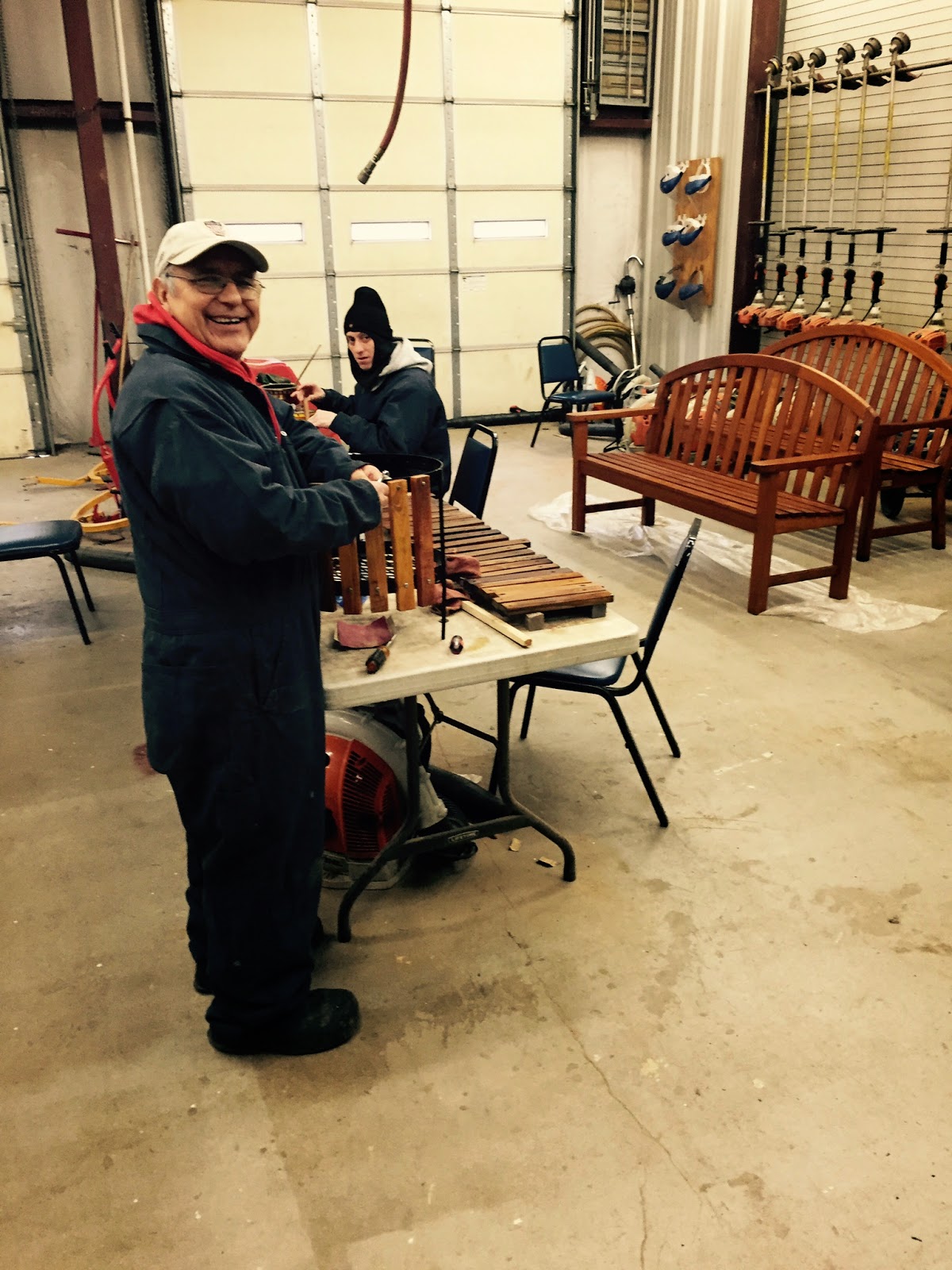
As most understand we take this time to do multiple projects around the course, drainage, tree work, clearing and general course maintenance.  Everything from items bolted down, to machines that run, need our attention before the long season.  Some simple examples are shown below.

Tee markers stripped down and stained 


A few of the over 25 mowing reels pulled off preparing for teardown

Benches, divot bottle holders, birdhouses all require sprucing up.

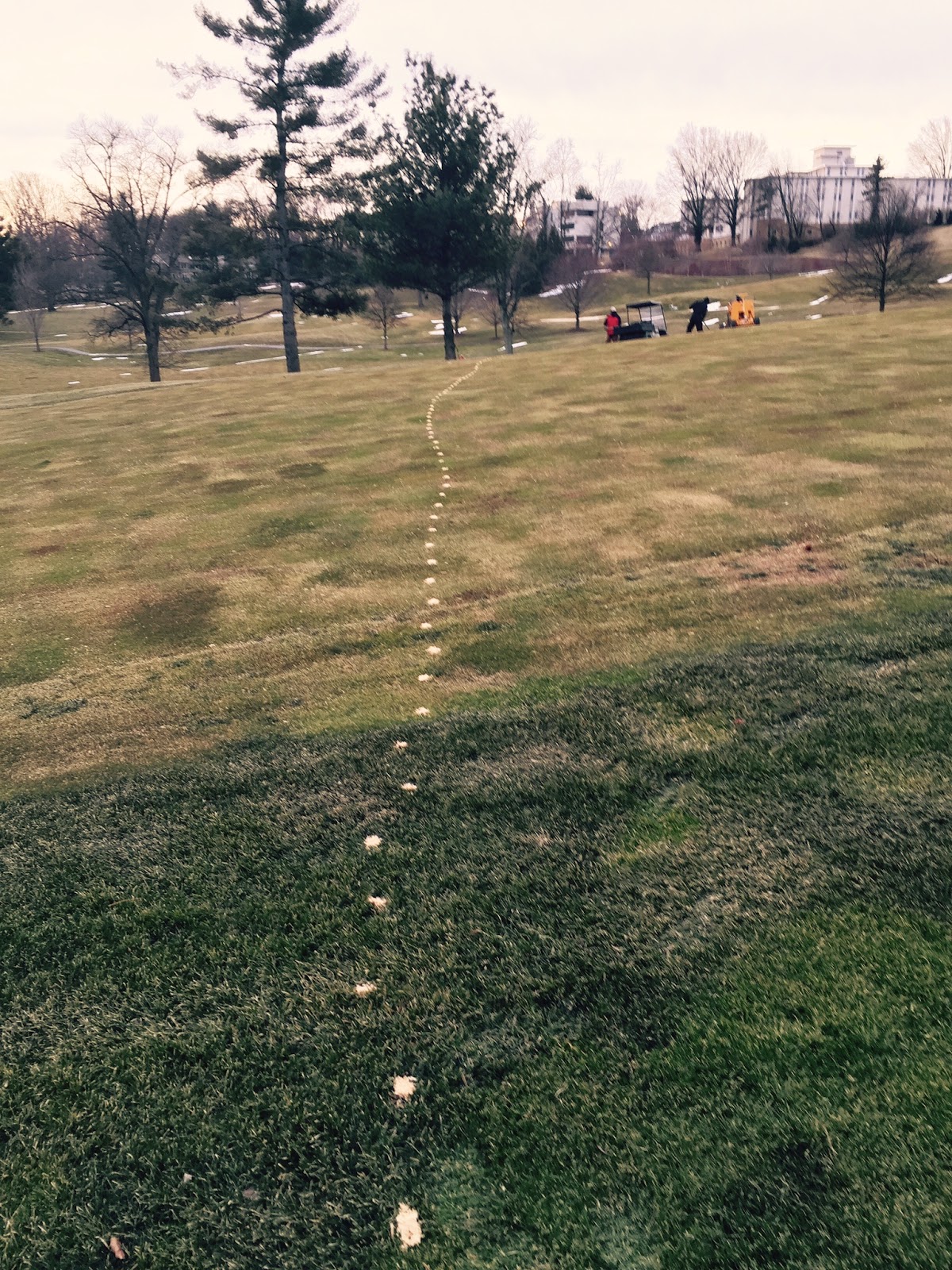
The picture below is a little quiz.  Can anyone identify how this perfect little trail of sawdust came to be stretched out across the 1st fairway and rough? 

Add caption
I'll provide an answer next week!

Monday, January 26, 2015

No Time for a Long Winters Sleep

As the days shortened and weather turned colder, we moved into action getting work done thats just not possible during the long days of summer.  What started with the renovation of the 2nd tee complex has moved into fairway drainage, the grassing and expansion of 15 fairway, wall building and some tree work.  I will try to cover as much of this as possible to bring everyone up to speed but many projects will just need to be seen as the weather warms and the days get longer.  Spring is on the way!


The 2nd tee proved an interesting and challenging project.  Take a small defined space, add improved cart paths, adequate tee space for a par 3, room for drainage and irrigation, then provide easy access to the 1st green all without walls to prop up the space.  We think we have accomplished all the goals while increasing teeing area and did not alter the layout of the hole.  We hope you like the look, everything in this small area is a trade off and we think we got the balance right.

While working the area we ran into some items that might have caused some of our prior issues.  In the back tee area a stump the size of a small truck was buried 6" under the surface, while on the front tee a boulder larger than any of our equipment was located barely under the teeing surface of the forward tee.  We had to create large burial holes because both items were too large to remove.  We literally had to roll them into holes.

In addition we added a new path inside the pine tree area to the right of the hole that will remove the player from the oncoming tee shot on 18.  This path is a new material, flex pave, that softens the impact of golf ball, and allows water and air to move through so not to damage tree roots.  This area will be playable by opening day.

Large bolder found under white tee

Stump buried under blue tee

Drain lines installed under surface

View from back of 2nd tee

New Flex Pave path to the right of the 2nd hole


After the 2nd tee we started the process of adding drainage to some our most troublesome areas.  The primary effort was focused on the 4th hole.  This hole suffers from a lot of shade,  large amounts of off site water intrusion from the neighborhood and poor air circulation.  This combined with a very limited hitting area makes this  challenge under the best of circumstances.

We cannot hope to solve all these issues at once, but we felt the ability to reduce the wet areas in the landing zones would be a good first step.  We began by capturing the majority of the water entering the course from the homes and piping it to the storm drains at the start of the fairway.  In addition we added several smaller catch basins and french drains in the main landing area of the tee shot.

After the crest of the fairway we constructed a series of basins and drains to remove the water from the long narrow section leading towards the green.  To remedy the cross bunker from washing out from off site runoff we reshaped the area to direct this flow to the new drains.

We also trimmed some trees along the hole to improve airflow and sunlight.  This process will be ongoing to improve conditions for turfgrass, as time has caused the canopy to become a hinderence to providing better conditions.


Added drainage to collect this off site water

Added drainage to capture this water


We began drainage work at the start of 12 fairway, and continue in the 15th fairway, and the bottom of 8 fairway and rough.  Much of this work is on hold due to weather and will be picked back up in the spring.   These works are an effort to improve infrastructure that will always be of benefit no matter the direction the course takes.   Most superintendents when asked what 3 things could be done to improve their course, respond with drainage, drainage and more drainage.


One project that has been on our minds for years was the replacement of the wall alongside the cart path from the 3rd green to the 4th tee.  The old wall was constructed from the remnants of one of the old pools.  A haphazard collection of broken concrete that was not representative of our continuing infrastructure improvements.  In addition to the wall, we will be replacing the old wooden stairs to the tee at 4, and the wooden steps leading from the range parking lot to the cart path at 4.  We hope this make a better presentation, a safer transition and one that is consistent with other past improvements.

New stone wall from 3 green to 4 tee area


We have taken the 15th fairway out of play for the winter while we performed several upgrades.  First we stripped the end of the fairway and replaced the sod as well as smoothed the surface.  This area is very similar to par 3 tees.  A lot of play from a limited hitting area, which becomes uneven after all the divot sand is applied.  Similar to the fourth fairway, this fairway is challenged by limited sun, air movement, poor drainage and limited hitting area.

When installing new turf we widened the hitting area closer to the creek, and smoothed out the fairway lines to reduce damage from fairways mowers.  This year we will be implementing maintenance practices more in line with a par 3 tees, with topdressing and fertilization practices modified for these areas.  Several trees have been limbed up for improved sightlines.

Just before winter set in we addressed an area of cart path that was some of the worst on the course.  The traverse from the 9th tee to green was a combination low area, drainage hole, red stone and wood timbers with poor asphalt.  We removed the old path, installed some drainage and removed the timbers while expanding the path.

Old path, a mix of surfaces and drainage issues

New path with better functionality

There has been normal tree maintenance around the course over the winter.  We selectively prune, and remove trees that we have observed over the past few growing seasons.  Some trees require us to take action due to safety concerns especially if they are in areas that see a large amount of traffic.  The picture below is an example of one such tree.  We have observed this oak tree for the past few years while we watched for signs of decline.  You can see what looked to most as a normal tree was completely rotted out and was leading to dangerous situation.


I will be making updates as we move towards spring, in the meantime firewood is ample supply, and the staff is busy refurbishing all the equipment and benches, birdhouses and other items that need our care.  The days are already getting longer, so get golf ready.


Thursday, October 9, 2014

Course Update


I'll start off by saying that there has been some spectacular weather recently and the mornings on the course have been beautiful.  At this point we have aerified the fairways, tees and greens.  Deposited over 40 tons of sand onto these surfaces, fertilized all the course and begun restoration of the range area.


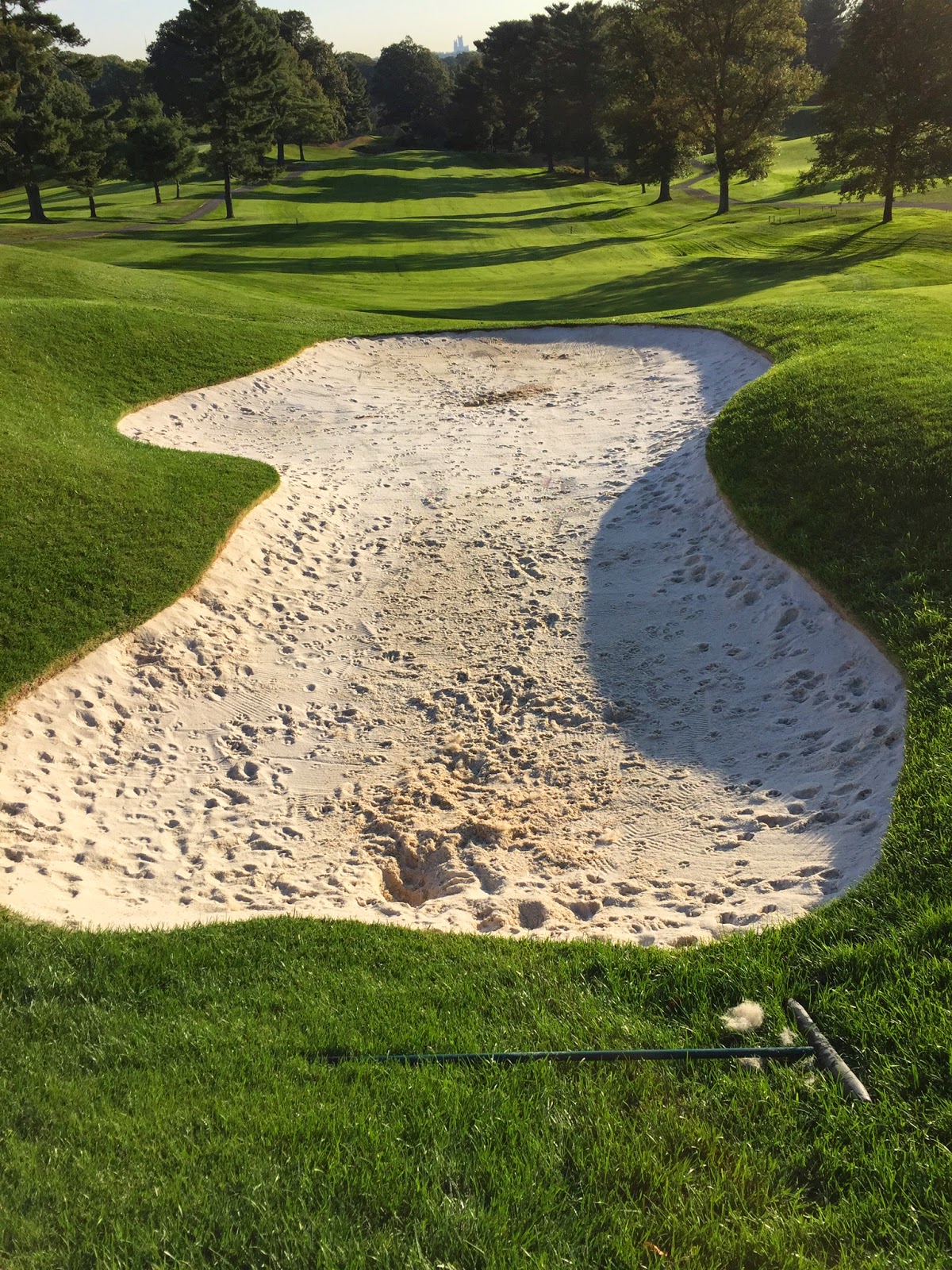
The foxes have been very active in the bunkers recently.   They dig all the way to the soil and gravel layer below bringing up all kinds of material which can make for quite a mess.  This leaves the bunker with a lot of gravel and very uneven.  Many times we do not have the time to adequately repair all the damage.  We start to fix only to find them torn apart the next day to an even worse condition.  


 Speaking of bunkers we hope to begin our normal refurbishment of bunker sand.  This is a regular fall project where we remove the sand from the worst bunkers and replace, checking the drainage, the layering, sod if needed and replace with fresh sand.  We prefer the fall for this operation as the bunkers are not frozen, the fall and winter rains can naturally pack and firm the sand to make it more uniform for next playing season.  Last winter was so early and lasted so long we did not get to perform this process and several bunkers ended up with less sand than normal over the course of the season.

Many times when we find a low bunker, it has become contaminated with gravel from the drainage, fox digging and soil from rainstorm washouts.  We remove all the sand and start fresh.  In the case of the bunker shown below, this happens to be the left green side bunker from 15, we find that a buildup of sand from play has radically altered the original contour and shape of the bunker.

The area at the rake shows a nearly 18" build up of sand towards the green, which must be removed, the area contoured back to the original soil line and sod replaced.  In this case, we will have to strip this all the way to the green to find the original soil lines and strip between the bunkers due to this buildup.


This is what we normally see after a year or two at the practice green bunker, but you can see what the effects are of play over the years from bunkers.  Many wonder why the sand in bunkers gets so low, well here is the visual proof of where it goes.  Normal bunker sand is usually 4-6 inches deep so that buildup is over three times the depth of the original bunker contents!


Speaking of our work on the range, we aerified the range, seeded, limed and fertilized the soil.  In addition we used cores from the aeration process to fill in may of the poorer soil areas.  The picture below shows a small sample of the rocks removed from the surface in the middle of the range.  The constant wear from the range picker, coupled with a range that was built from poor fill may help you to understand how hard it is to provide a quality surface when the ingredients are so poor.  We will continue to work as much as possible to improve this issue, but poor soil and drainage combined in a small space with heavy use work against us.


Below is a picture of the walk on to the 8th green.  We have experienced several times over the past few years the walk on to the green getting water saturated.  Why this happens continues to puzzle us.  There are no leaks, it goes a year without any issues then suddenly it becomes a quagmire.  Interesting that immediately below the surface everything is dry.  We strip the sod yet the soil an inch down is dry.  Irrigation has been turned off to rule out leaks and sprinklers checked to make sure none are stuck in a position that drowns the area.  It is fairly compacted from all the cart traffic (yes people park there) and shade and walk on traffic, so the grass is not deeply rooted.  But, it is a phenomenon that puzzles us and seems to have no rhyme or reason for its occurrence.  We will strip the area, try to let it dry for a day then sod again and see what happens.  We may have to resort to drains but the issue remains a mystery to us.


Monday, September 8, 2014

The saga of the 16th green

One of my favorite greens here at WGCC is the 16th green.  A beautiful surface that has great character.  Normally a green we we love with its bountiful sunshine, great air movement and abundent drainage, but this year it has proved a struggle.

You may have seen me at various times, poking and prodding at the green, several times with pathologists, superintednents and others walking the surface.   It's had it's share of samples taken from it and sent to labs all over the area.  I began to notice small irregular patches of dysfunticonal turf in several areas at the start of summer.  At the time it was diagnosed as a variety of poa annua that was not adapting to the climate at the time.

I had some samples sent off to look at chemical and physical composition of the soil and for any lingering disease.  All came back normal and the green bounced back.  As it started again, I sent more samples off looking at physical structure to determine if the sands we have been topdressing with had been causing any layering issues or dry down irregularities.  Again nothing found,  so I sent off some pictures to another friend of mine, a former turf professor now working as an advisor to a chemical company.  He wondered if we had tested for nematodes.

Now nematods are a small microscopic worm that inhabits all root systems and can cause injury.  Normally found in sandy soils in the south and problematic in the hot summer time, these worms feast off the roots structure weaking them when the plant is under stress.  Our 16th green is in a great growing environment, not under any undue stress and not a sandy soil.  Well as you can tell by now the samples I sent off to Virginia Tech came back with a high count of nematodes.

The soil aways contains nematodes, there are at least 25,000 species, and only certain ones cause issues, so trying to define how many and what type in any one location is difficult.

The chemistries to eradicate the worm is no longer on the market due to EPA issues.  So we are left to using a variety of methods re: "witches brews", to fight these parasites.  Anyway, everything seemed to be moving the right direction, to where most people never noticed any issues.

Well with this weekends high temperatures, the picture below show the damage in those stressed areas from the nematode presence.


We have applied more of the various brews to the soil (all natural) in the hopes of stemming the impact and will be researching all known practices this fall to work up a plan for next year.   We have tested several greens and recieved various counts, which even with todays science cannot define if we will have a problem or not down the road.  So when you see me kneeling down on the green with my knife in my hand, I'm not going crazy, just trying to stay ahead of whatever nature has tossed our way.


A beautiful start, then watch out for the downhill!


It was a glorious start to the day.  It is a wonderful place to be early in the morning as the sun rises over the 2nd green


As the sun rose we began to notice a few things that I want to alert you to as you play the course.  As I mentioned the downhill in the title is the one on the 8th hole.  When we make decisions as to determining the cart path rule, many assume it is just the very lowest areas that are affected.  Well recently we have seen a large increase in cart damage to the 8th hole.


As you can see above and below, long skids have torn the turf from the ground.  This not only impacts all the players, but is very difficult to remedy.  Bentgrass must be stripped and sodded, this results in mowing issues and playability issues.  Staked areas are then in play, carts continue to travel over the sod and in general it makes the aesthetics and playability poor overall.

We may have to resort to staking off the hill to all cart traffic if we cannot control this abuse.  Please exercise caution when starting down the hill, avoid sharp turns and lightly tap the brakes.  Use just as much caution when trying to climb the hill.  Many times you may not notice the tires spinning as you try to gain traction in your attempt to get back to your partners ball.  I recommend travelling down the rough until you are at the bottom of the hill then crossing the fairway at a 90 degree angle over to your ball.


Saturday, September 6, 2014

Fall Projects

Well it seems like summer just started and now we are talking about fall projects.  I will be adding some updates on things you may have noticed playing this summer, but for now I want to focus on what we are looking at for this fall.

The biggest change will be a renovation of the 2nd tee.  The supporting timber wall has been deteriorating for awhile.  Many designs have been evaluated in solving the problem, and been discussed by the appropriate committees.  The option moving forward is to remove the timber walls entirely, lower the back tee by a few feet and place it closer to the fence which allows a cart path to be placed between the tee and green for easier access to the first green.

This eliminates a long term issue for both the wall and stairs in this area.  In addition the middle tee will be lowered slightly, which will also create enough fill to increase the size of a new forward tee.  Even with lowering the tees, they will still be above the green height, and the expanded space and leveling will make all the tee area useable.

The new cart path will be done in concrete as a test for future cart path construction for the entire course.   In addition a cart path of a new material will be constructed to the left of the pine trees near the green to help with safety from the tee shots on 18.  This path will be out of play for 2, and will blend into the pine straw bed so as to not detract from the scenic nature of the hole.

The drawing below is a design sketch of the new tees.  Work will commence the first week of November.  We will have to shut down the tees during construction, but we are making plans to have a temporary set in several locations to allow the green to stay open.  Once the tees are finished we will evaluate the use of a mat on the new teeing areas while the sod knits in for an anticipated Spring opening.


We also are planning for drainage projects on the 3rd, 4th, 8th and 12th holes.  The largest of these projects will be on the 4th hole, as both the side toward the tee and the side toward the green will get new drainage to handle the abundant water that flows down this hole.

The tee side will have a large underground pipe connecting to several catch basins to remove surface water the emanates from the homes along the left side down into the storm basin at the beginning of the fairway.  These basins will be surface mounted so as to not collect shots into swales.

The green side will have a series of "french style" drains to capture water from both sides and move it down into the drains nearer the green.  In addition some work will be performed around the cross bunker to move water around it so we do not lose all the sand every time we receive a large downpour.

This work will commence shortly after the 2nd tee, and will require some alternate tee placements while the work is in progress.  This area will be back in play as soon as the project is complete and crews off site.

Monday, July 7, 2014

If it's the fourth of July then there must be a storm

As usual whenever the 4th of July rolls around it means fireworks, both at the club and in the skies.  Once again we saw a beautiful night for the annual fireworks, and the night before we saw a bigger natural light display with high winds and storms that once again split a few trees and damaged some beyond repair.  One pine in particular on 16 was torn apart and required the assistance of a crew to remove the remnants.


In addition to the tree we had another mishap that added to the lore of events on the 4th.  One of the mortars used in the fireworks display misfired and landed in the WGCC shrubs and caught fire.  How extensive the damage is has yet to be determined, but the short term effect is a nasty scar along the top of the G.


One of the tell tale signs of summer for us is the heat and the bright sun.  Turf stress begins to show symptoms due to the weather.  It also gives clues to the stress seen by golfers.  If you notice you can see two footprints in green with surrounding brown turf.  The damaged turf is from using spray sunscreen to coat your legs and the overspray burns the turf.  We promote the use of sunscreen to protect yourself from the harmful effects of the sun, but to avoid this turf damage apply when standing on a cart path or other hard pan area.  Your skin will be protected and turf damage can be avoided.


Many have inquired about the browned out grass area on the newly constructed bed above the 11th green.  When we developed this area we choose Zoysia sod to give us a low maintenance but attractive turf to reduce erosion on this hillside.  We also chose this warm season grass for its ability to take the southern exposure during the summer heat.  Unfortunately the first season we installed it was also one of the coldest winters in a long time.  The effects of a cold winter are seen in the picture below.  

Zoysia is a slow growing grass, and it would most likely recover in a year or two, but painfully slow for our needs.  We will be replacing this with a newer style Bermuda grass later this summer and try that approach.  Bermuda has the same tough characteristics and summer tolerance but with a hardier tolerance for extremes.  We will harvest the zoysia for use somewhere else on the course in an area that the slow recovery will not be so visible.